 10MathQ
Study guides › Level 7 · Geometry
Right triangles: the Pythagorean theorem
💡 The idea
In a right triangle (one with a square corner), the three sides are linked:
a² + b² = c²
Here a and b are the two shorter sides (the legs), and c is the longest side. It is called the hypotenuse, and it is always across from the square corner.
🪜 The steps
- Find the longest side first. It's the one across from the square corner.
- Missing the longest side: square both legs, add them, then take the square root.
- Missing a leg: square the longest side, take away the square of the leg you know, then take the square root.
✏️ Worked examples
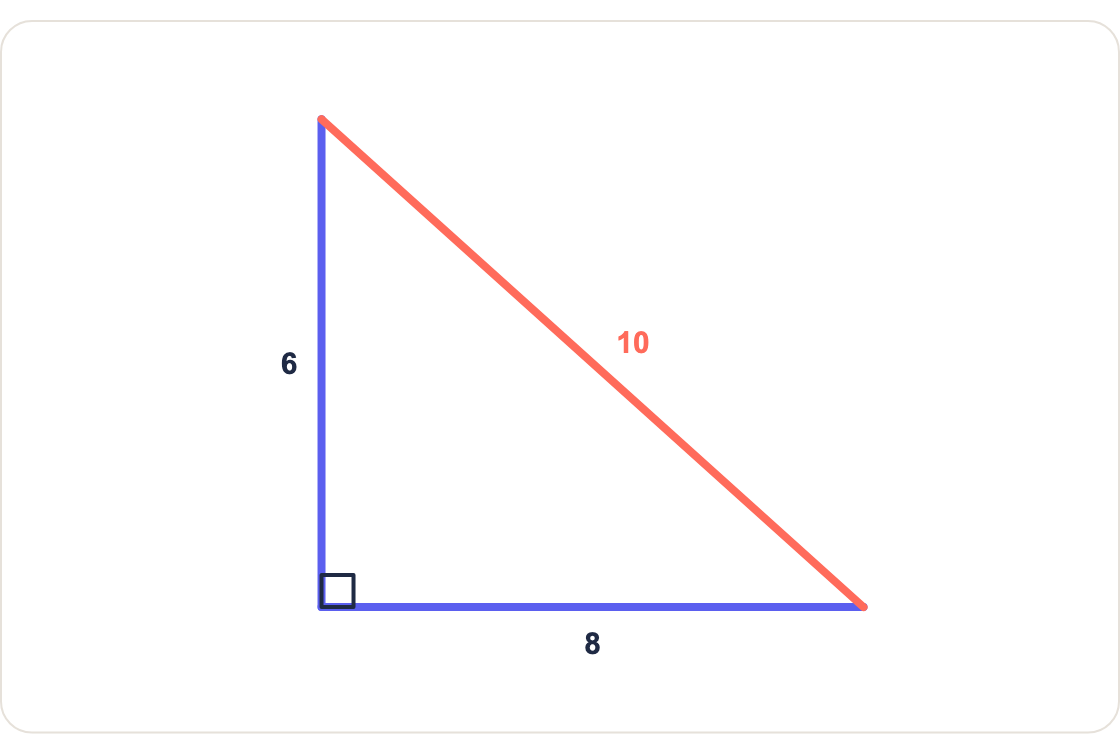
1. Legs of 6 and 8. How long is the longest side?
6² + 8² = 36 + 64 = 100, and √100 = 10.
2. The longest side is 13 and one leg is 5. How long is the other leg?
13² − 5² = 169 − 25 = 144, and √144 = 12.
⚠️ Watch out
- Add or take away? Add only when you're finding the longest side. Finding a leg means taking away.
- Don't stop at the square. In example 1, 100 is not the answer. Its square root, 10, is.
- Square corners only. The rule only works when the triangle has a right angle.
⚡ Handy shortcut
Some right triangles have all whole-number sides. Spotting one saves the work:
3-4-5, 5-12-13, 8-15-17, 7-24-25, and any of these made bigger (6-8-10, 9-12-15…).
🎯 Try these
- Legs of 9 and 12. Longest side?
- Longest side 25, one leg 7. Other leg?
- Legs of 20 and 21. Longest side?
Answers: 1) 15 2) 24 3) 29
This guide is also in the 10MathQ app: tap “📖 Study guide” after a question.